If you ask any manager what their biggest daily pain point is, the answer almost always includes two words: meetings and emails.
According to Flowtrace data (January 2026), professional workers in Chile and Latin America lose an average of 5 hours and 6 minutes weekly in unproductive meetings. That's 264 hours annually. More than 6 complete work weeks per year, literally sitting in a room (or in front of a screen) without making any concrete progress.
But here's the paradox: meetings are necessary. The problem isn't meetings themselves, but how we prepare, execute, and document them.
This article gives you 5 specific prompt structures you can use TODAY with Microsoft Copilot or any generative AI to recover at least 2 hours weekly of time lost in the meeting cycle. No vague theory. Copy-paste structures that work.
The Real Cost of Inefficient Meetings
Before diving into solutions, let's understand the magnitude of the problem.
The Numbers Nobody Wants to See
Global statistics (2026):
- 24 billion hours are lost annually in unproductive meetings worldwide
- 71% of professionals consider meetings a waste of time
- Only 11% of meetings are considered truly productive
- 37% of US companies don't even use an agenda in their meetings
For managers and executives specifically:
- An average CEO spends 72% of their time in meetings
- Middle management spends 35% of their work week in meetings
- VP-level or higher executives average 17 meetings weekly
Where Time is Actually Lost
Lost time is NOT just during the meeting. It's the complete cycle:
Before the meeting:
- 40% of workers lose up to 30 minutes just finding where to hold it
- Average preparation time: 1 hour and 9 minutes per meeting
- Schedule coordination: 15-20 additional minutes
During the meeting:
- 10 minutes and 40 seconds average start delay
- 73% of participants multitask (aren't really present)
- 39% have admitted to falling asleep in a meeting
After the meeting:
- 77% of meetings end by scheduling... another meeting
- 54% of participants leave without clarity on next steps
- Follow-up and clarification time: 30-45 additional minutes
Real total per 1-hour meeting: 3-4 hours of organizational time lost.
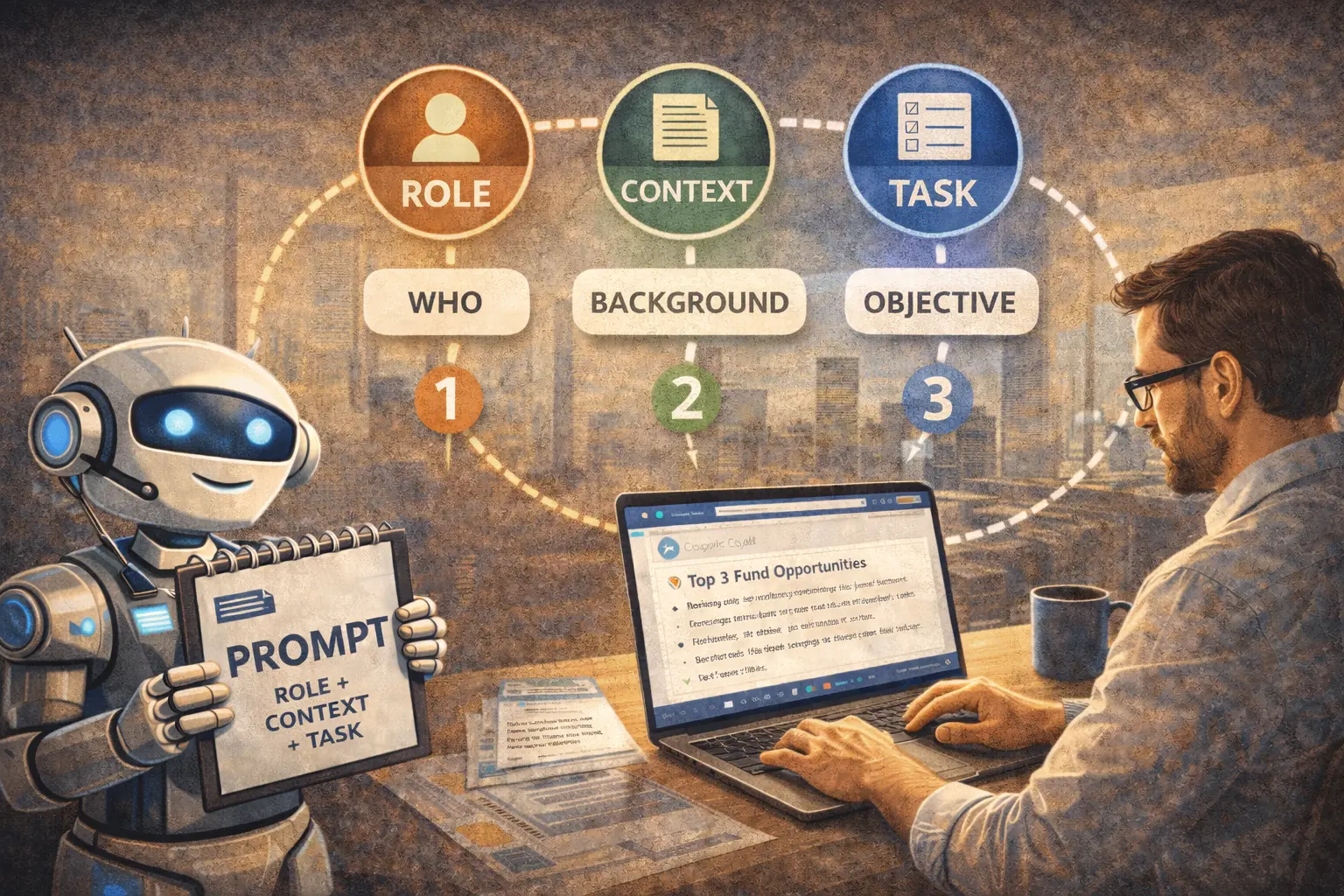
The Base Framework: ROLE–CONTEXT–TASK–FORMAT
Before giving you the 5 specific structures, you need to understand the framework that supports them. This is the same one we teach in our Microsoft Copilot Executive Workshop.
The 4 components:
1. ROLE
Define who the AI is for this specific task.
❌ Bad: "Summarize this meeting"
✅ Good: "Act as an executive assistant expert in documenting operational coordination meetings"
2. CONTEXT
Provide relevant information the AI needs to understand the situation.
❌ Bad: No context
✅ Good: "This is a weekly coordination meeting between operations and logistics management at a transportation company. 8 people participate and it typically lasts 60 minutes"
3. TASK
Specify exactly what it should do.
❌ Bad: "Help me with this"
✅ Good: "Generate an executive summary of maximum 200 words identifying: (1) decisions made, (2) action items with owners, (3) pending topics for next meeting"
4. FORMAT
Define how you want the output.
❌ Bad: (no specification)
✅ Good: "Present in 3 sections with bullets. Use bold for owner names and italics for deadlines"
Structure #1: Express Pre-Meeting Preparation
Problem it solves: You arrive at meetings without complete context, lose the first 15 minutes "catching up".
When to use it: 10 minutes before any recurring meeting about a specific project or topic.
Tool: Microsoft Copilot in Teams
Template
ROLE: Act as my executive assistant who has followed the entire history of [project/topic name].

CONTEXT: I have a meeting in 10 minutes about [topic]. The latest relevant conversations are in this Teams channel / these emails / this document folder.

TASK: Give me a 5-point executive brief that includes:
1. Last important decision made and when
2. Pending resolution topics
3. Commitments I assumed in previous meetings
4. Questions or conflict points likely to resurface
5. Key data I should have fresh (metrics, dates, budgets)

FORMAT: Numbered list. Maximum 150 words total. Prioritize most recent (last 2 weeks).
Real Example - Transportation Industry
Prompt input:
ROLE: Act as my executive assistant who has followed the Q1 2026 route optimization project.

CONTEXT: I have a meeting in 10 minutes with operations team. Topic: progress on new routing system implementation. Teams channel: "Smart Routing Project".

TASK: Give me a 5-point executive brief that includes:
1. Last important decision made and when
2. Pending resolution topics
3. Commitments I assumed in previous meetings
4. Questions or conflict points likely to resurface
5. Key data I should have fresh

FORMAT: Numbered list. Maximum 150 words total.
Typical Copilot output:
1. LAST DECISION: Jan 22 - Approved pilot in Metropolitan Region with 15 routes during February (management meeting).

2. PENDING: Definition of pilot success KPIs, driver training budget approval ($3.5M), integration with current GPS system.

3. YOUR COMMITMENTS: Coordinate with IT technical validation before Jan 31, present complete business case to board Feb 15.

4. LIKELY CONFLICTS: Driver union resistance (mentioned in 3 meetings), legacy GPS compatibility (recurring technical issue).

5. KEY DATA: 12% fuel savings projection, 8-month expected ROI, $28M total investment, pilot involves 45 drivers.
Time saved: 15 minutes of "catch up" at meeting start + avoid forgetting commitments = ~20 minutes per meeting.
Structure #2: Post-Meeting Summary in 30 Seconds
Problem it solves: You lose 30-45 minutes writing minutes or sending follow-ups. Nobody reads them because they're too long.
When to use it: Immediately after any recorded meeting with transcription.
Tool: Microsoft Copilot in Teams (requires recording enabled)
Template
ROLE: Act as an executive secretary expert in concise meeting documentation.

CONTEXT: [Duration] meeting about [general topic]. Participants: [roles, not names if many]. Meeting objective was [objective].

TASK: Generate structured executive summary in 4 sections:
1. DECISIONS: What was definitively decided (maximum 3 points)
2. ACTION ITEMS: Assigned tasks with format "WHO must do WHAT by WHEN"
3. PENDING TOPICS: What remained unresolved and requires follow-up
4. NEXT MEETING: Date, specific objective, or indicate if not necessary

FORMAT: Bullets. Bold for owner names. Italics for dates. Maximum 250 words total.
Real Example - Mining Industry
Prompt input:
ROLE: Act as executive secretary expert in mining safety meeting documentation.

CONTEXT: 60-minute meeting about Q4 2025 incident review. Participants: Operations Manager, Safety Chief, 3 shift supervisors. Objective was to analyze root causes and define preventive plan.

TASK: [same template as above]

FORMAT: [same format as above]
Typical Copilot output:
DECISIONS:
- Double verification system will be implemented in shift change for critical equipment
- $8M budget approved for Mine 3 ventilation system upgrade
- Mandatory monthly training replaces current quarterly training

ACTION ITEMS:
- **Carlos Muñoz** (Safety Chief) must present detailed double verification protocol by *Feb 15*
- **Ana Silva** (Operations) coordinates with suppliers for ventilation system quote by *Feb 22*
- **Pedro Lagos** (HR) adjusts 2026 training calendar and notifies supervisors by *Jan 31*

PENDING TOPICS:
- Cost-benefit evaluation of additional IoT sensors (requires deeper technical analysis)
- Coordination with union on shift protocol changes

NEXT MEETING: Feb 12, 10:00 AM. Objective: Validate proposed protocols and implementation timeline.
Time saved: 30-40 minutes of minutes writing + 10 minutes of sending and formatting = ~45 minutes per meeting.
Structure #3: Multi-Meeting Commitment Extraction
Problem it solves: You forgot what you committed to in the last 5 meetings. Monday arrives and you don't know where to start.
When to use it: Start of week or before 1:1 with your boss.
Tool: Microsoft Copilot in Teams or Outlook
Template
ROLE: Act as my personal commitment management assistant.

CONTEXT: I am [your role] and participated in multiple meetings during [period: last week / last 2 weeks / this month]. I need to consolidate all my pending commitments.

TASK: Analyze transcriptions/follow-up emails from my meetings in [specific channel/folder] and generate:
1. List of ALL commitments I explicitly assumed
2. Group by: (a) Overdue, (b) This week, (c) Next 2 weeks
3. For each commitment indicate: WHAT I must deliver, to WHOM, WHEN, and in WHICH meeting it was agreed

FORMAT: Table with columns: Commitment | Recipient | Deadline | Source Meeting | Status
Sort by urgency (overdue first).
Real Example - Financial Sector
Prompt input:
ROLE: Act as my personal commitment management assistant.

CONTEXT: I am Credit Risk Deputy Manager and participated in 8 meetings during the last 2 weeks (Teams channel "Risk Committee" and emails tagged "Corporate Credit").

TASK: [same template as above]

FORMAT: [same format as above]
Typical Copilot output:
| Commitment | Recipient | Deadline | Source Meeting | Status |
|---|---|---|---|---|
| SME segment non-performing portfolio analysis | General Management | Jan 25 | Risk Committee 01/18 | ⚠️ OVERDUE |
| Scoring matrix update companies >UF 50k | Sales Team | Jan 31 | Products Meeting 01/22 | 🔴 This week |
| Construction sector limit adjustment proposal | Board | Feb 5 | Executive Committee 01/19 | 🟡 Next 2 weeks |
| Team training on new scoring system | HR Chief | Feb 15 | 1:1 with Manager 01/20 | 🟢 Ample deadline |
| Quarterly provisions report | Internal Audit | Feb 28 | Audit Committee 01/17 | 🟢 Ample deadline |
Time saved: 20 minutes searching emails and Teams + 15 minutes manually building list = ~35 minutes weekly.
Structure #4: Intelligent Agenda Generation
Problem it solves: You call a meeting but the agenda is vague ("align on project X"). Result: unfocused meeting that goes off track.
When to use it: When scheduling any meeting involving complex decisions or coordination.
Tool: Microsoft Copilot in Outlook or Word
Template
ROLE: Act as a professional executive meeting facilitator.

CONTEXT: I need to call a meeting about [general topic]. Participants: [roles/areas]. Duration: [30/60/90 minutes]. Business objective: [what I need to achieve by meeting end].

TASK: Design a structured agenda that includes:
1. Meeting title (clear and actionable)
2. Specific objective (1 phrase, format "By the end of this meeting we will have...")
3. Time blocks with specific topics (assign minutes to each)
4. For each block: Block objective + Expected deliverable
5. Preparation materials attendees should review BEFORE
6. Decisions that MUST be made before finishing

FORMAT: Structured document. Use table for time blocks. Bold for critical decisions.
Real Example - Retail/Manufacturing
Prompt input:
ROLE: Act as professional retail operations meeting facilitator.

CONTEXT: Meeting about Q1 inventory optimization. Participants: Operations Manager, Purchasing Chief, Demand Analyst, Controller. Duration: 60 minutes. Objective: Define optimal stock levels by category and replenishment policy to reduce stockouts without increasing immobilized capital.

TASK: [same template as above]

FORMAT: [same format as above]
Typical Copilot output:
MEETING: Q1 Inventory Optimization – Stock Policy Definition

OBJECTIVE: By the end of this meeting we will have defined target inventory levels by category A/B/C and approved new automatic replenishment policy.

AGENDA:

| Time | Topic | Block Objective | Deliverable |
|------|-------|-----------------|-------------|
| 5 min | Context and objective | Align everyone on current situation | - |
| 15 min | Q4 2025 data review | Identify categories with highest stockout vs. overstock | Prioritized list of 10 critical categories |
| 20 min | Target levels proposal | Validate or adjust Demand Analyst proposal | Approved levels for cat. A (70% of value) |
| 15 min | Automatic replenishment policy | Define triggers and frequency | Decision matrix: WHEN to replenish HOW MUCH |
| 5 min | Financial impact | Validate budget feasibility with Controller | Go/No-Go for implementation |

PRE-MEETING PREPARATION (review before meeting):
- Q4 2025 rotation dashboard (sent by Demand Analyst)
- Updated ABC classification proposal (attached)
- Category stockout report last quarter

CRITICAL DECISIONS TO MAKE:
1. ✅ Target stock levels by category A/B/C
2. ✅ Replenishment frequency (weekly/biweekly)
3. ✅ Additional budget required (if applicable)
4. ✅ Pilot implementation date
Time saved: 25 minutes thinking about structure + meeting 20% shorter and more effective = ~35 minutes per organized meeting.
Structure #5: Unnecessary Meeting Detection
Problem it solves: You accept meetings by default. Many could be emails or Teams messages.
When to use it: When you receive a meeting invitation and aren't sure if your presence is necessary.
Tool: Microsoft Copilot in Outlook
Template
ROLE: Act as my executive time management advisor.

CONTEXT: I received meeting invitation with title "[meeting title]". Participants: [list]. Duration: [X minutes]. Agenda/description: [copy invitation description].

TASK: Evaluate if my presence is really necessary by analyzing:
1. Can the objective be achieved without a meeting? (email, Teams chat, collaborative document)
2. Is my role active (decide, approve, contribute expertise) or passive (just receive info)?
3. Is there someone else on my team who could attend in my place?
4. Does the meeting have clear agenda and measurable objective?
5. Is the requested time proportional to the objective?

Based on the analysis, give me:
- Recommendation: ATTEND / DELEGATE / DECLINE
- Main reason (1 phrase)
- If decline: draft diplomatic declination message with alternative

FORMAT: Structured response in 3 sections. Maximum 150 words.
Real Example - Cross-Industry
Prompt input:
ROLE: [template above]

CONTEXT: Invitation "ERP Modernization Project Kickoff - Informational Session". 12 participants (managers from all areas). 90 minutes. Agenda: "Vendor presentation on project timeline and scope".

TASK: [template above]
Typical Copilot output:
ANALYSIS:

1. Can it be achieved without meeting? YES – Vendor can send presentation + pre-recorded video
2. Is your role active? NO – It's informational session, doesn't require decisions from your area
3. Can someone else attend? YES – Your Project Manager could represent the area
4. Clear agenda? PARTIAL – It's just "presentation", no specific objectives
5. Proportional time? NO – 90 min to receive info that can be consumed in 20 min

RECOMMENDATION: **DECLINE** (delegate attendance)

REASON: Your presence is not critical in an informational session without decision-making; your Project Manager can attend and share executive summary with you.

DECLINATION DRAFT:

"Thank you for the invitation. To optimize my schedule, I'm delegating my attendance to [Name - Project Manager] who has complete project context and can effectively represent our area. I ask that they share executive summary afterwards and any decision requiring my approval. I remain available for specific meeting if any topic arises requiring my direct participation."
Time saved: 90 minutes of unnecessary meeting + 15 min travel/preparation = ~105 minutes per intelligently declined meeting.
ROI Calculator: How Much Time Would You Recover?
Let's do the real calculation for your case.
Conservative assumptions:
| Structure | Weekly Frequency | Savings per Use | Weekly Savings |
|---|---|---|---|
| #1 Pre-Meeting | 3 meetings | 20 min | 60 min |
| #2 Post-Meeting | 2 meetings | 45 min | 90 min |
| #3 Multi-Commitments | 1 time (Monday) | 35 min | 35 min |
| #4 Intelligent Agenda | 1 meeting | 35 min | 35 min |
| #5 Unnecessary Meetings | 1 declined | 105 min | 105 min |
| WEEKLY TOTAL | 325 minutes |
325 minutes = 5.4 hours weekly = 280 hours annually = 7 complete work weeks.
And this is being conservative. If you're a manager with 12+ weekly meetings, savings can reach 8-10 hours weekly.
Common Mistakes When Using These Structures
Mistake #1: Prompts Too Vague
❌ Bad: "Summarize the meeting"
✅ Good: Use complete template with ROLE-CONTEXT-TASK-FORMAT
Why it matters: Copilot/AI can give you 5 pages of summary nobody will read, or 3 bullets that omit what's critical. Specificity is key.
Mistake #2: Not Iterating the Prompt
❌ Bad: Copy template, use it once, if it doesn't work perfectly you abandon it
✅ Good: Use output, identify what's missing or extra, refine the prompt
Why it matters: First prompt is 70% of the result. Refining it 2-3 times gives you 95%.
Mistake #3: Not Validating Critical Outputs
❌ Bad: Send Copilot summary directly to entire team without reading
✅ Good: Validate that decisions and commitments are correct before sharing
Why it matters: AI can misinterpret. YOU are responsible for final output.
Mistake #4: Using AI for Everything
❌ Bad: Try to have AI make meeting decisions
✅ Good: Use AI to document, synthesize, remember. YOU decide.
Why it matters: AI is assistant, not replacement for human judgment.
Implementation Checklist (Next 7 Days)
Day 1-2: Setup
- Verify you have access to Microsoft Copilot (E3/E5 with Copilot license)
- Activate transcription in Teams for your meetings
- Save the 5 prompt structures in quick reference document
Day 3-4: First Test
- Use Structure #1 (Pre-Meeting) in your next meeting
- Document time saved vs. traditional preparation
- Refine prompt based on result
Day 5-6: Expansion
- Implement Structure #2 (Post-Meeting) in 2 meetings
- Share an AI-generated summary with your team (validate reaction)
Day 7: Measurement
- Use Structure #3 (Multi-Commitments) to consolidate your week
- Calculate total time saved in 7 days
- Decide which structures to integrate permanently
Realistic goal: If you save 2 hours in the first week, you've already recovered the time to read this article 12 times.
Frequently Asked Questions
Do these prompts work with ChatGPT or only with Copilot?
They work with both, but there are critical differences:
- Microsoft Copilot: Access to your emails, Teams, documents. Integrated corporate context.
- ChatGPT: You must manually copy-paste. Risk of leaking confidential information.
Recommendation: Use Copilot for sensitive corporate information. ChatGPT only for practice or general cases without real data.
Do I need to be "technical" to use these structures?
No. If you can send an email or use WhatsApp, you can use these structures.
The ROLE-CONTEXT-TASK-FORMAT framework doesn't require programming, just clarity when writing instructions.
What do I do if the AI output isn't perfect?
It's normal. 3-step strategy:
- Validate the output (never share without reviewing)
- Refine the prompt adding more specificity where it failed
- Iterate 2-3 times until result is consistently good
Rule of thumb: If after 3 attempts it doesn't improve, the problem is the prompt (not the AI).
Can I use this with my entire team?
Yes, and you should. In fact, ROI multiplies when the entire team uses the same structures:
- Consistent meeting summaries
- Uniformly documented commitments
- Less ambiguity in follow-ups
Suggestion: Share the 5 structures in a team document and schedule 30 min for everyone to try together.
Additional Use Cases by Industry
Transportation and Logistics
Most valuable structure: #3 (Multi-Commitments)
Why: Constant coordination between operations, maintenance, drivers, customers. Easy to lose track of commitments in 15+ weekly meetings.
Additional specific prompt:
Analyze operational coordination meetings last 2 weeks. Identify: (1) Routes with recurring incidents, (2) Pending preventive maintenance commitments, (3) Customers with unresolved complaints.
Mining
Most valuable structure: #2 (Post-Meeting)
Why: Safety and operation meetings require strict documentation for compliance. Critical time.
Additional specific prompt:
Generate safety meeting minutes necessarily including: reported incidents, corrective actions with owners, required training, equipment to review. Chilean standard NCh compliance format.
Financial Sector
Most valuable structure: #5 (Unnecessary Meetings)
Why: High load of committee meetings, regulatory reports, multi-area coordination. Need to prioritize where you really add value.
Additional specific prompt:
Evaluate if this committee meeting requires my presence or I can send written report. Consider: are there credit decisions?, is my approval required?, can I delegate to senior analyst?
Concrete Next Steps
Option 1: Try the 5 Structures This Week
No cost. No commitment. You just need:
- Access to Microsoft 365 (if you have Outlook/Teams, you already have it)
- 10 minutes to save the structures
- Willingness to try in your next meeting
Expected result: You recover at least 1 hour in the next 7 days.
Option 2: Learn the Complete Framework in 4 Hours
These 5 structures are just the tip of the iceberg. In our Microsoft Copilot Executive Workshop you learn:
- Complete framework ROLE-CONTEXT-TASK-FORMAT applied to 20+ use cases
- Live demonstrations in Word, Excel, PowerPoint, Teams
- Practical exercise with YOUR data and YOUR real meetings
- 30-day adoption plan with savings metrics
Next available dates:
- Week of Feb 17-21 (2 slots)
- Week of Feb 24-28 (3 slots)
Option 3: Download the 5 Structures in Editable Format
Downloadable version with:
- The 5 copy-paste structures in Word
- 10 additional examples by industry
- ROI measurement template
- 15-minute tutorial video
Conclusion: 2 Hours Isn't Little, It's 5% of Your Week
If you work 40 hours weekly, 2 hours are 5% of your total time. Applied to a year, that's 104 hours = 13 complete work days.
For a manager earning $4,000,000 CLP monthly, that's approximately $650,000 CLP annual value in recovered time.
For a company with 10 managers using these structures: $6,500,000 CLP annually in recovered productivity.
And that's without counting secondary value:
- Less stress from chaotic meetings
- Better commitment tracking
- Greater clarity in team communication
- Faster and better documented decisions
The question isn't whether these structures work. Data confirms it. The question is whether you can afford another month losing 8+ hours weekly in the unproductive meeting cycle.
Related articles: