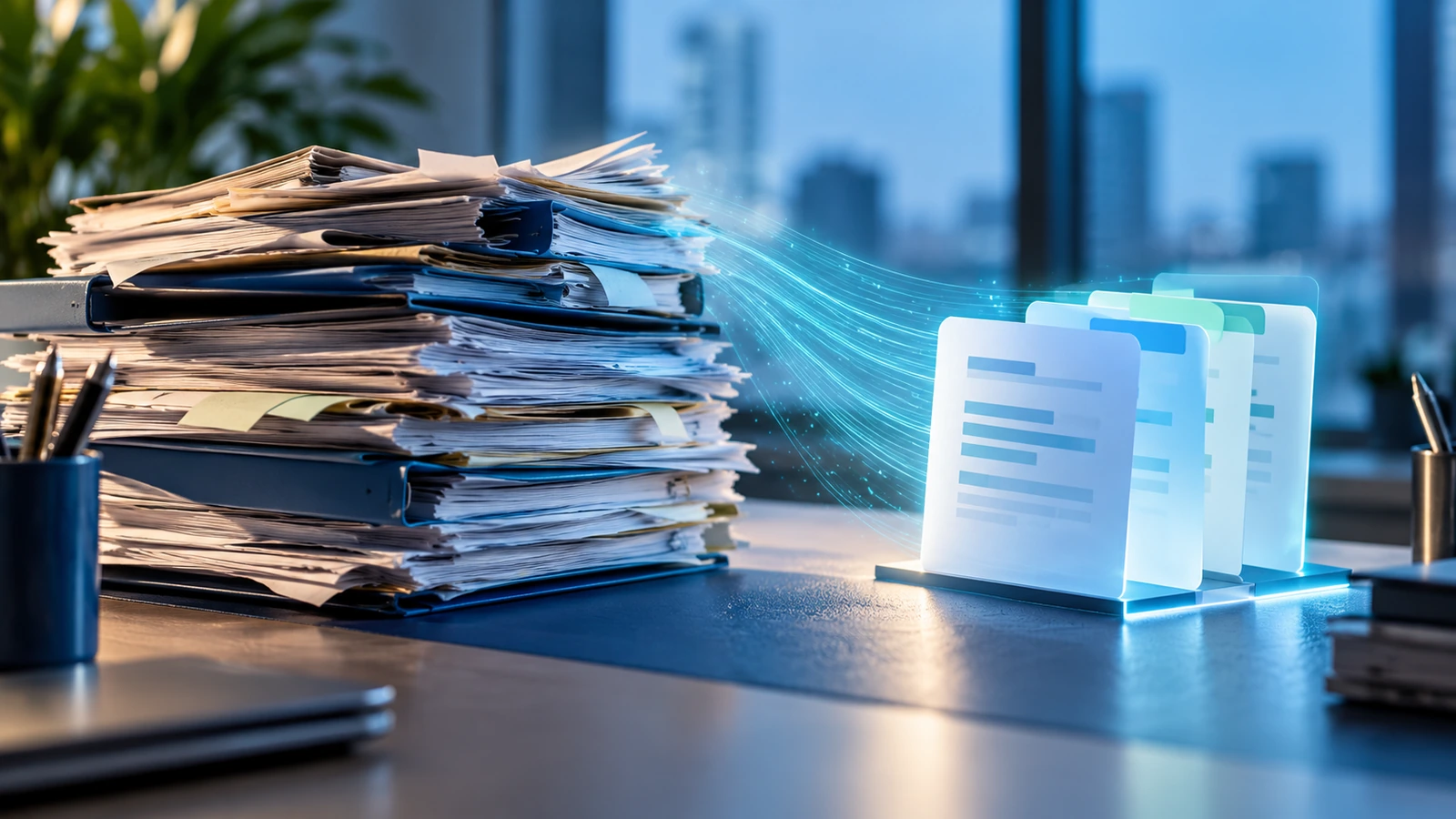
The program that calculates sales commissions was written by someone who retired in 2014. It's in RPG, it runs on an AS/400, and nobody wants to touch it. Every time the commercial policy changes, IT asks for two weeks "to look into it," and the answer is almost always the same: do it by hand in Excel and load the adjustment later.
Plenty of Chilean companies will recognize that scene, and it's often what pushes them to look for software development consulting. The system works, the business depends on it, and nobody fully understands it. The question we hear now is whether AI can help modernize legacy software without betting the operation on a full replacement project. It can, though not at every stage, and not without a method.
Why legacy software isn't replaced in one go
The temptation is to rewrite everything in a modern stack and switch the old system off on a Friday. That rarely works. Legacy software carries decades of business rules that aren't written down anywhere else: a tax exception, a discount for a long-standing customer, a validation someone added after an expensive mistake. Rewrite without knowing those rules and you lose them. You find out when a customer complains.
That's why the usual architecture advice is to migrate in pieces. The Strangler Fig pattern, documented in Microsoft's Azure Architecture Center, puts a façade in front of the old system and moves features one by one to the new one while the old one keeps running. Once nothing depends on it, you turn it off. The same guide says the pattern isn't a good fit when the system is small and easy to replace outright, or when there's no way to intercept calls to the legacy system.
To migrate in pieces you have to know what's inside. That's where AI is more useful than many people expect.
Where AI helps in a modernization project
AI saves the most time on understanding code that nobody documented. That's usually the slowest and most expensive stage of a modernization project, and the one most often underestimated in a quote.
For some languages, there are already tools built for this. GitHub Copilot modernization is generally available for language, framework and toolset upgrades in .NET, Java and C++ applications, and for .NET and Java migration scenarios to Azure. It analyzes dependencies and outdated libraries, builds a plan, applies changes, checks that the project still builds, and scans for known vulnerabilities (CVEs) after the upgrade. Microsoft's own documentation says humans stay in the loop and every change can be reviewed.
On IBM i, the platform AS/400 systems run on, IBM announced on July 9, 2026 the general availability of the IBM Bob Premium Package for i. According to IBM, it works with RPG, COBOL, CL and Db2 for i, explains complex programs, generates technical documentation and unit tests, and converts fixed-format RPG to free format.
Split by task, the work looks roughly like this:
| Task | What AI does | What your team checks |
|---|---|---|
| Understanding the code | Explains programs and modules in plain language | Whether the explanation matches how the business actually runs |
| Documentation | Describes functions, inputs and outputs | That business rules are named correctly |
| Dependency mapping | Shows which program calls which, and which tables it touches | Integrations the tool can't see, like flat files or nightly jobs |
| Tests | Proposes unit tests based on current behavior | That they cover the edge cases that matter |
| Code upgrades | Moves framework versions forward and replaces deprecated APIs | That the result behaves exactly as before |
Understanding, documenting and testing come first. Before you move a single line, you need tests that describe how the system behaves today, so you can prove later that the new one does the same.
Where to start: a five-step plan
A well-run legacy modernization project doesn't start by writing new code. This order keeps the risk down:
- Take an inventory of programs, tables, interfaces and integrations. This is where companies often find processes nobody remembered, like a file sent to the bank every night.
- Use AI to explain and document the critical modules, and check each explanation with the people who know the process. Someone with fifteen years in the area will spot in minutes what the model made up.
- Before changing anything, write tests that describe current behavior. AI helps you write them faster.
- Pick a first module that is small, visibly useful and has few dependencies. A lookup portal or a report is a better starting point than payroll.
- Integrate before you replace: expose legacy data through APIs so new applications can live alongside the old system. The business sees results while the core stays stable.
AS/400 and JD Edwards: modernize without switching off the core
With AS/400 and JD Edwards the question is rarely "migrate or not." The core is usually stable and fast. The trouble is the user experience, how hard it is to connect to other tools, and the shrinking pool of people who know RPG.
Progressive modernization can leave the ERP where it is and build around it: APIs that expose data in near real time, web or mobile apps for users who shouldn't have to deal with a green screen, and connections to Azure, Power Platform or Dynamics 365. AI helps the team understand the RPG code before touching it, and it helps document what used to live in one person's head. If you run JD Edwards, we covered the options for maintaining and upgrading it in JD Edwards on AS/400: maintenance and upgrades without migrating.
Risks to keep in mind
- A model can describe, with complete confidence, a rule the code doesn't apply. If nobody from the business reviews it, that error ends up in the official documentation.
- Legacy code often comes with real customer or employee data, and sending it to an external tool without assessing that first is a compliance problem. Chile's Law 21.719 on personal data protection is legally set to take effect on December 1, 2026. There is a bill in the Senate to postpone it, but until it is published as law, that date stands.
- Before using any assistant, find out what gets sent to external services and what is retained. For GitHub Copilot modernization, Microsoft says code snippets aren't retained beyond the session.
- Generating new code is fast. Verifying it isn't. We looked at the data in Software development with artificial intelligence today.
What to expect from software development consulting
If you're bringing in outside help to modernize, the proposal should answer these questions before it gets to technology:
- How will they capture the business rules that today exist only in the code?
- Which AI tools will they use, and what code or data will leave your infrastructure?
- What tests will exist before each module changes?
- What gets modernized first, and why?
- How will the old and new systems coexist during the transition?
If the answer is a plan to rewrite everything in a year, be wary.
Frequently asked questions
Can AI migrate my legacy system automatically?
Not end to end. It speeds up tasks like understanding code, documenting it, writing tests and upgrading versions in supported languages. Architecture decisions and validating business rules are still work for people.
Do I have to replace the AS/400 to modernize?
Not necessarily. Many companies keep the core on IBM i and modernize around it with APIs, web and mobile apps, and cloud integrations.
How long until we see a first result?
It depends on the system, but the first module should be chosen precisely so it shows value early. An inventory and AI-assisted documentation already give you something useful before any code changes.
Progressive modernization, with your operation running
At Disrupsoft we build custom software and integrate legacy systems like AS/400 and JD Edwards with Azure, Power Platform and Dynamics 365, using secure APIs and progressive modernization. We use AI where it shortens the work, and our team checks every decision with the people who know your business. If you have a system nobody dares to touch, let's talk.