A chatbot tells you your order is in transit. An AI agent notices it's running late, checks available stock in the ERP, recalculates the route, and lets the customer know the new delivery date — without anyone touching a thing. That difference sounds minor until you're the one deciding whether to give an autonomous system write access to your database.
For an IT team in Chile, the real challenge of integrating AI isn't getting access to a language model — that part's basically solved and almost trivial at this point. The challenge is connecting that model to the company's ERPs, databases, and business rules without opening a security hole or running afoul of Law 21.719 in the process.
From answering questions to taking action
A traditional conversational assistant stays in the conversation. An AI agent integrated into corporate software goes further: it reads input data, checks it against business rules, and carries out a real action in the system — updates a record, fires off a notification, changes a status in the ERP. That jump, from "answering" to "acting," is what completely changes the bar for security and control.
Where this is already working in Chile
This isn't theoretical. There are three kinds of use cases where AI agents are already solving real problems for Chilean companies.
In logistics, automating the reading and entry of dispatch notes, electronic invoices, and customs paperwork straight into the management system, so nobody has to transcribe anything by hand. In financial services, analyzing transaction patterns in real time to catch anomalies and speed up credit evaluation. And in operations and after-sales, classifying support tickets, checking a customer's history in the CRM, and applying refund or warranty rules automatically.
The pattern repeats across all three: the agent handles the repetitive work of gathering information and applying a rule, leaving people to focus only on what actually needs human judgment.
The four principles that shouldn't be up for negotiation
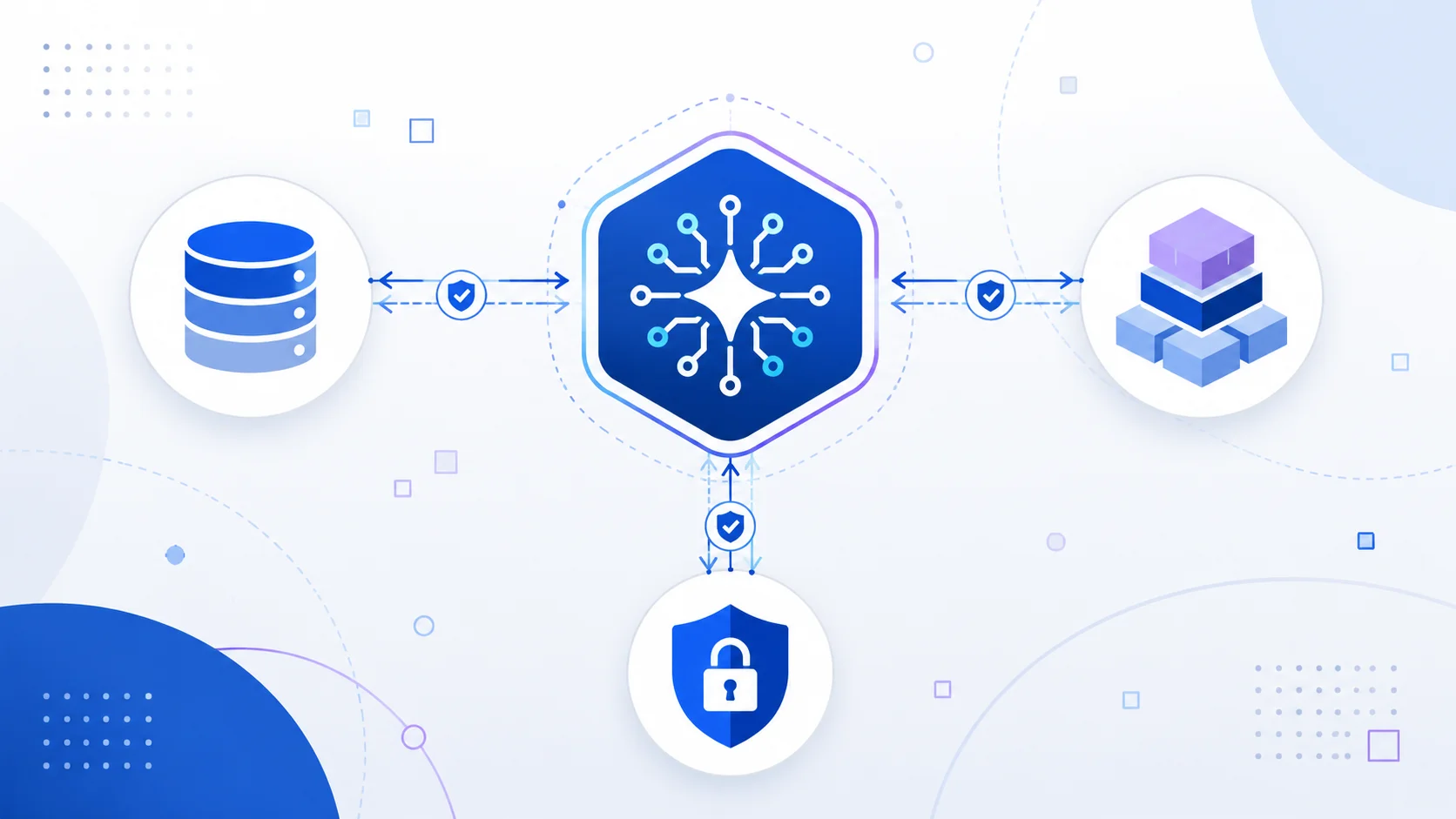
The most common fear among CTOs evaluating this isn't that the AI will get something wrong — it's that confidential information leaks out, or that an external model ends up training on company data without anyone authorizing it. Four things handle most of that risk:
- RAG architecture instead of retraining. The model isn't trained on your data — it queries a private, encrypted vector database only at the moment it needs to answer. Data never leaves the company's controlled environment.
- Law 21.719 compliance. Processing Chilean customer data has to respect consent, data minimization, and encryption both in transit and at rest — that's not optional, and it reaches full effect on December 1, 2026.
- Granular permissions (RBAC). The agent should inherit exactly the same permissions a person doing that task would have, not one bit more. Without that, a misconfigured agent can end up seeing financial or strategic information it has no business touching.
- A human in the loop for anything critical. Approving a payment or modifying a contract shouldn't sit entirely with the agent. There, the system prepares the action and waits for explicit sign-off from someone with the authority to make the call.
How to move forward without funding a project that never ships
The most common way this fails isn't technical — it's scope. "AI for the whole company" projects that never reach production because they try to solve everything at once. It works better to go piece by piece.
Start by identifying a single repetitive operational process that eats up a lot of manual time today — not the most complex one, the most repetitive one. Then validate it with a three-to-four-week proof of concept using real data, before writing a single line of production code. Only then connect the model — OpenAI, Anthropic, or a self-hosted open-source option, depending on how sensitive the data is — to the custom software via APIs. And once it's in production, monitor continuously how accurate the agent is and how often it gets things wrong — that's not a one-time check, it's an ongoing one.
It doesn't replace your system, it strengthens it
Integrating AI agents doesn't mean tearing out the infrastructure you already have or rewriting your ERP. It means giving that system the ability to handle, on its own and with oversight where it matters, the repetitive work that's currently eating up your team's time.
At Disrupsoft, we build custom software and integrate agentic capabilities under serious cybersecurity and compliance standards. If you want to figure out where an AI agent makes the most sense in your current systems, book a no-commitment technical assessment.